

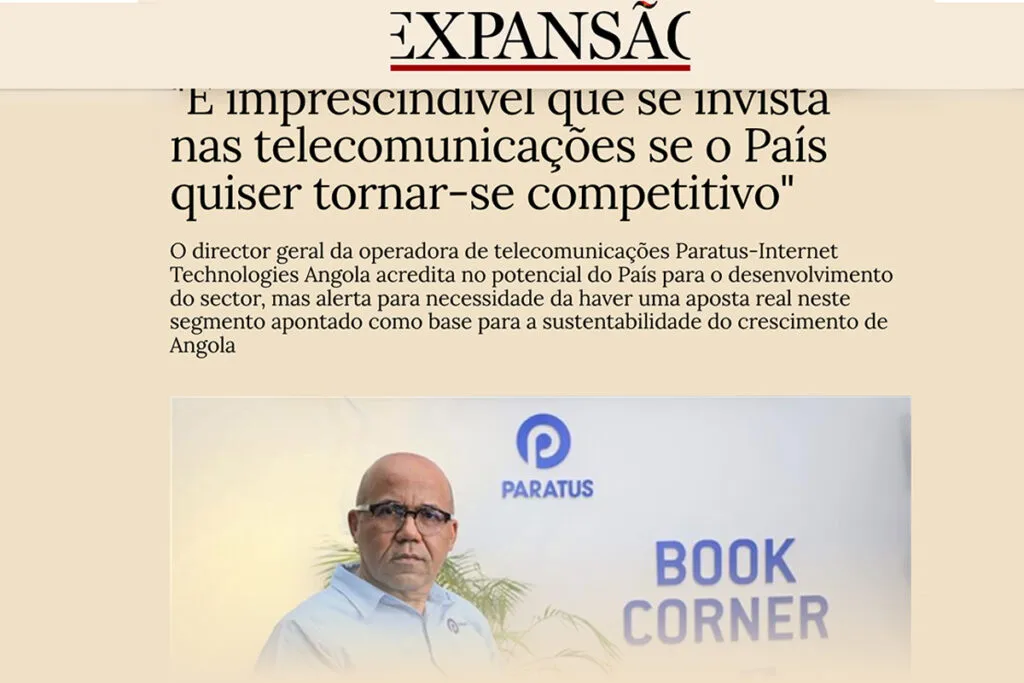
It is essential to invest in telecommunications if the country wants to become competitive.
The CEO of telecommunications operator Paratus-Internet Technologies Angola believes in the country's potential for developing the sector, but warns of the need for real investment in this segment, which is seen as the basis for Angola's sustainable growth.
Paratus Internet Technologies Angola has been one of the telecommunications companies in the market for several years. What is the current situation of the sector in the country?
The sector is in line with the country's overall economic situation. As we know, our economy has been experiencing ups and downs since independence, and the sector is no exception to this situation. Telecommunications is a capital-intensive sector, and this capital is indexed to foreign currency. This year, we have seen a sharp devaluation from January to date, which has forced companies to review their investment plans. On the other hand, in terms of operations, i.e., companies' operating costs, we still have some costs indexed to foreign currency, such as content, licenses, the space segment, and international communications, which means that companies are managed very rigidly and with restricted processes in order to remain in the market.
With these constraints, is it possible to bring telecommunications up to the standards of other regions, such as SADC?
In many ways, we are above the regional level. Each country has its own specific characteristics. If we look at Namibia, for example, it is a very different reality from the Democratic Republic of Congo, Mozambique, or Botswana. We often make comparisons and take the context out of the comparison. I can say that Paratus, in terms of data centers, is on par with international data centers, including those in Europe. It is true that we still have many challenges, much to do in terms of expanding the network itself to the east of the country. The country is developing a lot along the coast. Secondly, I am talking about municipalities and other levels, over the years many investments were made at the beginning and perhaps we were not so effective in this investment.
Why?
It wasn't just in telecommunications. It was also in other sectors, partly due to the desire to build the country quickly. And I'm talking mainly about the post-war period. And it wasn't just the public sector; the private sector wasn't as assertive either. Today, the situation is different. There is more maturity in the sector, investments are now made in a more assertive manner, but in any case, we still have a lot to do.
We have situations like the ones happening now, where when there is a fault in a submarine cable, we experience difficulties with telecommunications services. Are situations like this still justified in the market?
Angola is privileged. There are countries that are in worse situations than ours. Three cables pass through Angola. WACS and SAT3, which run from Cape Town to Portugal, and these two were affected. But we have an alternative in the cable to Brazil. On the other hand, with other operators like us, we were able to direct traffic to South Africa and then use a fourth cable that does not land in Angola, but passes along the west coast of Africa, which is Equiano, and we took our traffic to Europe. At the moment, there are not so many constraints, but the cables have not yet been repaired. There was a period when operators had to better balance their traffic, which is normal in this operation.
Why do these cable breaks occur?
It's normal for this to happen. Probably due to the current of the Congo River where the break occurred, but the other cable is operational and has been the mainstay of international communications in Angola.
What can we still improve in terms of telecommunications operations?
We have a lot to do. Take, for example, the sharing of telecommunications infrastructure. By sharing infrastructure, operators will optimize their investment costs. For example, it doesn't make much sense for several operators to lay fiber optics on the same side of the road between Luanda and Benguela. When an incident occurs, such as a landslide or a bridge collapse, Benguela is left without communications.
Is that a problem?
If infrastructure were shared, for example, fiber optics or even services, regional concessions could be made. One operator would go directly to Benguela via Sumbe, another could go via Waku Kungo, and a third could go via Huambo and from Huambo to Lobito, forming a national network. The winners would be investment, companies, and the public, who ultimately foot the bill for investments. Not to mention service quality. That is what is lacking.
There is legislation on infrastructure sharing. Is it not being enforced?
The legislation is very well drafted, but it remains to be implemented in practice.
Is there a lack of willingness among operators?
The regulator has done a remarkable job in this regard. But there is still some reluctance, even on our part as operators. Perhaps what is needed is greater action and a stronger sense of regulation on the part of the regulator itself to enforce the law.
Could this be related to mistrust among operators?
This is not only the case in Angola. Countries that now share infrastructure to a large extent have also gone through this process. It is natural that operators come with a history of building their own networks and do not want to share infrastructure. But then the maturing of the telecommunications ecosystem itself leads everyone, regulators and operators alike, to understand that it makes sense and to move towards sharing. We need to do things quickly, we have to skip steps, and we have no other alternative if we want to catch up with other leading countries. But we also have to be patient on some issues.
By not sharing infrastructure, aren't they making the telecommunications business more expensive?
We could share investments, and this would ultimately be reflected in some way in the final price of telecommunications. But I don't want to send the wrong message here that this is the main factor behind what are referred to as high telecommunications prices in Angola, which I absolutely disagree with. Telecommunications in Angola are cheap.